
Auto care is one of the largest and most durable categories in franchising. There are more than 290 million registered vehicles in the United States, and every single one of them needs service. That baseline demand doesn’t go away during recessions, and it doesn’t depend on trends or consumer sentiment. It’s structural.
But not all auto care franchises are built the same. A quick-lube shop and a mobile fleet maintenance franchise are both “auto care”, but they operate completely differently, attract different customers, and have very different economics for the owner. Choosing the right model matters a lot more than choosing the right industry.
Here’s a breakdown of every major type of auto care franchise, what each one involves, and where the real growth opportunity is heading.
Why Auto Care Is One of the Safest Industries to Franchise In
Think about what drives demand in automotive service: people need to get to work, businesses need their fleets running, deliveries need to go out. None of that stops when the economy slows down. In fact, during downturns, people tend to hold onto their vehicles longer instead of buying new ones, which actually increases maintenance demand. It’s one of the few business categories where a soft economy can work in your favor.
That resilience is why automotive franchises have long attracted entrepreneurs who want a business with strong fundamentals. But resilience is table stakes. The investors building the most durable operations are the ones who pair industry stability with a business model that’s aligned with where demand is actually growing.
That’s where understanding the different franchise models becomes essential.
Traditional Full-Service Repair Shop Franchises
This is the classic model most people picture when they think “auto repair franchise.” Brands like Midas, Meineke, and Maaco operate this way. You lease or own a physical shop, hire technicians, and build your business by serving local consumer vehicles. The model is well-established and many franchisees have built solid businesses with it.
The tradeoffs are real though. You’re carrying significant fixed overhead in rent, equipment, and staffing. Customer acquisition depends heavily on your location and local reputation. And in most markets, competition from both other franchises and independent shops is intense. Growth typically means opening another location, which means doing it all over again.
Best fit for: Owners who want a community-facing business, have strong local ties, and are comfortable managing a physical operation with employees on-site daily.
Quick-Service Maintenance Franchises
Think Jiffy Lube, Valvoline Instant Oil Change, or Take 5. These franchises focus on high-volume, fast-turnaround services like oil changes, tire rotations, and fluid checks. The customer experience is built around speed and convenience, and the business model depends on keeping bays moving.
The model works when you have great visibility and traffic counts. The challenge is that margins on routine maintenance are thin, and you’re largely competing on convenience and price. Scaling means opening more locations. Best fit for: Investors who want a standardized, systemized operation in a high-traffic area and are comfortable with volume-driven economics.
Specialty Automotive Service Franchises
This category includes franchises focused on a specific type of service: transmission repair (AAMCO), brake and exhaust work, auto glass replacement (Safelite has a licensing model), collision repair (CARSTAR, Maaco), or detailing. The specialization can justify higher ticket values and create a reputation in a defined niche.
The tradeoff is that you’re more dependent on a narrower demand stream, and some specialties require significant equipment investment or highly skilled technicians who are hard to find and retain. Best fit for: Owners with industry background or technical knowledge who want depth over breadth.
Auto Parts and Dealership-Adjacent Franchise Models
Some automotive franchise opportunities sit closer to retail than service. Parts stores like NAPA Auto Parts operate dealer and franchise models. Used car dealership franchises like Carmax have licensing arrangements. These businesses benefit from brand recognition and established supply chains, but they tend to come with higher capital requirements, more complex inventory management, and a very different operational profile than a service-focused franchise.
Best fit for: Well-capitalized investors with retail or dealership experience who want to operate within an established brand ecosystem rather than build a service-based client book.
Mobile Fleet Service Franchises: The Model Built for Where the Industry Is Heading
Mobile fleet service is the fastest-growing segment in automotive franchising, and the reason is simple: commercial fleet operators need maintenance but can’t afford to take their vehicles off the road. A delivery company with 30 vans can’t pull them all into a shop for oil changes. A construction firm running equipment across three job sites doesn’t want to deal with tow trucks and shop wait times. They need someone who comes to them.
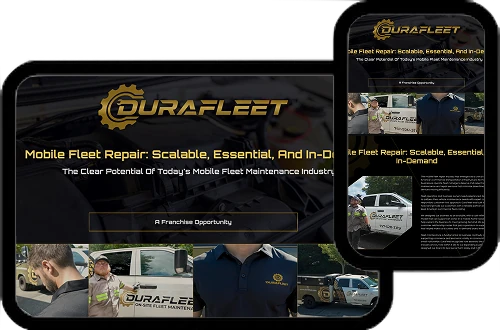
That’s what DuraFleet does. As a franchise owner, you build a territory of commercial clients and service their fleets on-site. No storefront required. No waiting for foot traffic. Your customers are businesses with ongoing maintenance needs, and once you establish trust with them, that turns into recurring revenue through service agreements and scheduled maintenance contracts.
The overhead is lower than a shop-based model. The customer relationships are stickier. And the growth path, adding more clients and technicians within your territory, doesn’t require opening a second location.
Best fit for: Investors who want recurring revenue, lower overhead, and a business model built around long-term commercial relationships rather than consumer foot traffic.
What the Industry Trends Are Telling You Right Now
E-commerce isn’t slowing down, and every package that gets delivered needs a vehicle to deliver it. That means more last-mile delivery fleets, more commercial vans on the road, and more demand for the kind of on-site maintenance that keeps them moving. Infrastructure spending is pushing construction equipment into the field. And fleet managers, under pressure to reduce operating costs, are increasingly adopting preventive maintenance programs because they’ve learned that scheduled service is far cheaper than emergency repairs.
Modern vehicles are also more complex than ever, which raises the value of structured, professional service over DIY fixes. All of this points in one direction: the commercial fleet maintenance segment is growing, and it’s growing faster than the consumer side of the market.
Investors who position themselves in front of that growth now are entering markets that will only become more competitive over the next five years.
How to Actually Choose the Right Auto Care Franchise for You
Start by being honest about what kind of business you actually want to run. Do you want a physical location with walk-in customers, or a service operation built around commercial client relationships? Do you want to compete on convenience and volume, or on reliability and specialization? Your answer to those questions will narrow the field quickly.
Then look at the economics: how does the model generate revenue, and is it recurring or transactional? What does the overhead structure look like? How do you grow; by opening more locations, or by adding more clients within your existing territory? A model with recurring commercial revenue and a lower overhead footprint is going to give you more flexibility and more predictability than one that depends on foot traffic and quarterly ad spend.
Finally, look at what the franchisor actually provides beyond the brand name. Territory analysis, training quality, ongoing support, technology systems; these vary significantly and have a direct impact on how fast you can build a profitable operation.
Interested in the Mobile Fleet Model? Here’s Where to Start.
DuraFleet is a mobile fleet maintenance franchise designed for owners who want recurring revenue, lower overhead, and a business built on long-term commercial relationships. You service fleets on-site, build a territory of commercial clients, and grow without the cost of a physical storefront.
If that sounds like the kind of business you want to own, reach out to the DuraFleet team. We’ll walk you through available territories, what the market looks like where you want to operate, and what ownership actually involves from day one. No pressure, just real information.
FAQs
What are the main types of auto care franchises?
The main categories are full-service retail repair shops (like Midas or Meineke), quick-service maintenance concepts (like Jiffy Lube or Valvoline), specialty service franchises focused on a specific system like brakes or transmission (like AAMCO), auto parts and dealership-adjacent models, and mobile fleet service franchises like DuraFleet. Each has a different cost structure, customer base, and growth model.
Which auto care franchise models are growing the fastest?
Mobile fleet service is one of the fastest-growing segments right now. The expansion of e-commerce delivery fleets, construction activity, and commercial logistics is driving demand for on-site fleet maintenance that traditional shops simply can’t provide. The model is gaining traction because it solves a real problem for commercial operators: keeping vehicles running without pulling them off the job.
Do I need mechanical experience to own an auto care franchise?
For DuraFleet, no. Your job as an owner is to run the business: build commercial client relationships, manage your technicians, and grow your territory. The technical work is done by trained technicians. That said, understanding what your team does will help you sell the service and build credibility with clients. For other franchise models, it depends — some specialty repair concepts do benefit from a technical background.
Is auto care franchising a recession-resistant investment?
Generally, yes — and more so for fleet service than consumer repair. Vehicles need maintenance regardless of economic conditions, and businesses that depend on commercial fleets can’t put off service without risking costly breakdowns. During economic downturns, consumers also tend to delay buying new vehicles and invest more in maintaining the ones they have, which increases service demand overall.
How do I figure out which auto care franchise model is right for me?
Start with the type of customer you want: consumers or commercial clients. Then look at how the business generates revenue — is it transactional or recurring? From there, evaluate overhead, scalability, and what the franchisor provides beyond brand recognition. If recurring revenue, lower overhead, and commercial relationships appeal to you, mobile fleet service is worth a serious look. If you want a community-facing storefront with walk-in traffic, a retail or quick-service model may be a better fit.